
Turkey2018DHSProfessionalHelp
Skilled birth attendance broadly follows the definition of SDG indicator 3.1.2 Proportion of births attended by skilled health personnel. However, it refers to the proportion of women (rather than births) who have given birth in the past 5 years with the attendance of skilled health personnel.
Turkey2018DHSOverweight
Overweight follows the definition of SDG indicator 2.2.2 Prevalence of malnutrition (weight for height >+2 standard deviation from the median of the WHO Child Growth Standards) among children under 5 years of age.
Data Source: DHS
The following data are considered for this analysis:
• Children ages 0 - 5 who have been measured (PR - Household Member Recode)
Turkey2018DHSContraceptiveMethod
Family planning (demand met with modern methods) follows the definition of SDG indicator 3.7.1 Proportion of women ages 15-49 years who have their need for family planning satisfied with modern methods. It refers to the percentage of women of reproductive age (15-49 years) currently using a modern method of contraception among those who desire either to have no (additional) children or to postpone the next pregnancy.
Turkey2018DHSInternetuse
Internet usage broadly follows the definition of SDG indicator 17.8.1 Proportion of individuals using the internet.
Data Source: DHS
The following data is considered for this analysis:
• Individuals: women ages 15-49 (IR-Individual Recode for women)
• Use of the internet: in the past 12 months
Turkey2018DHSSafeSanitation
Basic sanitation follows the definition of SDG indicator 1.4.1 Use of improved facilities that are not shared with other households. This indicator is also related to: 6.2.1 Proportion of population using safely manages sanitation services, including a hand-washing facility with soap and water.
Turkey2018DHSBasicWater
Basic drinking water follows the definition of SDG indicator 1.4.1 Use of drinking water from an improved source that is available with a collection time of not more than 30 minutes for a round trip, including queuing. This indicator is also related to: 6.1.1 Proportion of population using safely managed drinking water services.
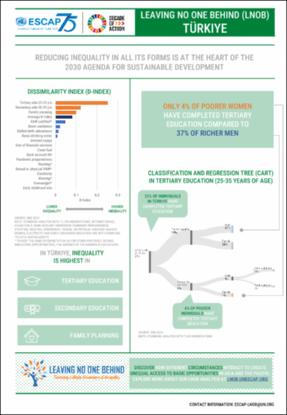
Türkiye LNOB Brief-DHS (2013)
Leaving No One Behind (LNOB) tool helps discover how different circumstances interact to create unequal access to basic opportunities in Asia and the Pacific. The LNOB country brief for Türkiye provides insights into which groups are further ahead and further behind in various SDG indicators and where the biggest gaps are found in terms of access to opportunities or prevalence of barriers between the furthest behind and the furthest ahead groups in Türkiye.


