

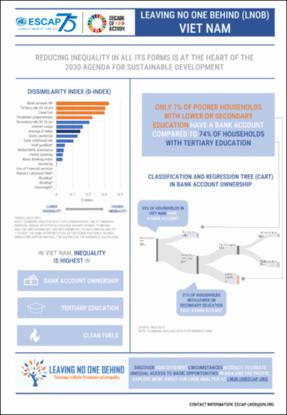
Viet Nam LNOB Brief-MICS (2013)
Leaving No One Behind (LNOB) tool helps discover how different circumstances interact to create unequal access to basic opportunities in Asia and the Pacific. The LNOB country brief for Viet Nam provides insights into which groups are further ahead and further behind in various SDG indicators and where the biggest gaps are found in terms of access to opportunities or prevalence of barriers between the furthest behind and the furthest ahead groups in Viet Nam.
Vietnam2021MICSLanguage
The analysis "including ethnicity, language and religion", is formulated with additional circumstances added to the standard model. The Vietnam MICS 2021 includes the following Languages: • VIETNAMESE • TAY, MUONG, THAI, NUNG • KHMER • MONG • OTHER LANGUAGE Note: The group Other includes religions, ethnicities or languages that represent less than 5% of the population for the purpose of this analysis.
Vietnam2021MICSFinancialInclusion
Use of financial services follows the definition of SDG indicator 8.10.2 Proportion of adults (15 years and older) with an account at a bank or other financial institution or with a mobile money-service provider.
Data Source: MICS
The following data are considered for this analysis:
• Individuals: women and men ages 15 - 49 (WM-Individual Women's Survey)
Vietnam2021MICSBankCardHH
Bank account (Household) measures the proportion of households with at least one household member with an account at a bank (household-level). It broadly follows the definition of SDG indicator 8.10.2 Proportion of adults (15 years and older) with an account at a bank or other financial institution or with a mobile money-service provider.
Data Source: MICS
The following data are considered for this analysis:
• Household-level data (HH-Household Survey).
Vietnam2021MICSHigherEducation35plus
Tertiary education (attended, 35+ yrs) measures the proportion of individuals older than 35 who have attended higher education. It broadly corresponds to SDG indicator 4.3.1 Participation rate of youth and adults in formal and non-formal education and training in the previous 12 months.
Data Source: MICS
The following data are considered for this analysis:
• Individuals: women and men ages 35 and older (HL - Household Questionnaire at the individual level)
• Tertiary education is defined as any education beyond upper secondary.
Vietnam2021MICSHigherEducation2535
Tertiary education (attended, 25-35 yrs) measures the proportion of 25-35 year olds who have attended higher education. It broadly corresponds to SDG indicator 4.3.1 Participation rate of youth and adults in formal and non-formal education and training in the previous 12 months.
Data Source: MICS
The following data are considered for this analysis:
• Individuals: women and men ages 25 - 35 (HL - Household Questionnaire at the individual level)
• Tertiary education is defined as any education beyond upper secondary.
Vietnam2021MICSSecondaryEducation35plus
Secondary education (completed, 35+ yrs) measures the proportion of individuals older than 35 who have completed upper secondary education. It broadly follows the definition of SDG indicator 4.1.2 Completion rate (upper secondary education).
Data Source: MICS
The following data are considered for this analysis:
• Individual data for women and men ages 35 years and older (HL - Household Questionnaire at the individual level)
• Completed upper secondary, where upper secondary refers to grade 12.
Vietnam2021MICSSecondaryEducation2035
Secondary education (completed, 20-35 yrs) measures the proportion of 20-35 year olds who have completed upper secondary education. It broadly follows the definition of SDG indicator 4.1.2 Completion rate (upper secondary education).
Data Source: MICS
The following data are considered for this analysis:
• Individual data for women and men ages 20 - 35 (HL - Household Questionnaire at the individual level)
• Completed upper secondary, where upper secondary refers to grade 12.
Vietnam2021MICSEarlyChildhoodEducation
Early childhood education broadly follows the definition of SDG indicator 4.2.2 Participation rate in organized learning. The age range considered is 36-59 months.
Data Source: MICS
The following data are considered for this analysis:
• Children between 36 and 59 months of age (CH - Under-five Survey) who are attending an early childhood education programme.


